My Successful Classroom (Most of the Time)
What Do We Even Mean by “Successful”?
A successful classroom does not happen overnight.
If it did, someone would have written a very expensive book about it already and we’d all be following The 3-Step Calm Classroom Method™ while drinking our coffee hot.
Instead, it takes time. Trial and error. Conversations that don’t always go smoothly. Adjustments. Stepping back. Trying again. And then trying again… and again.
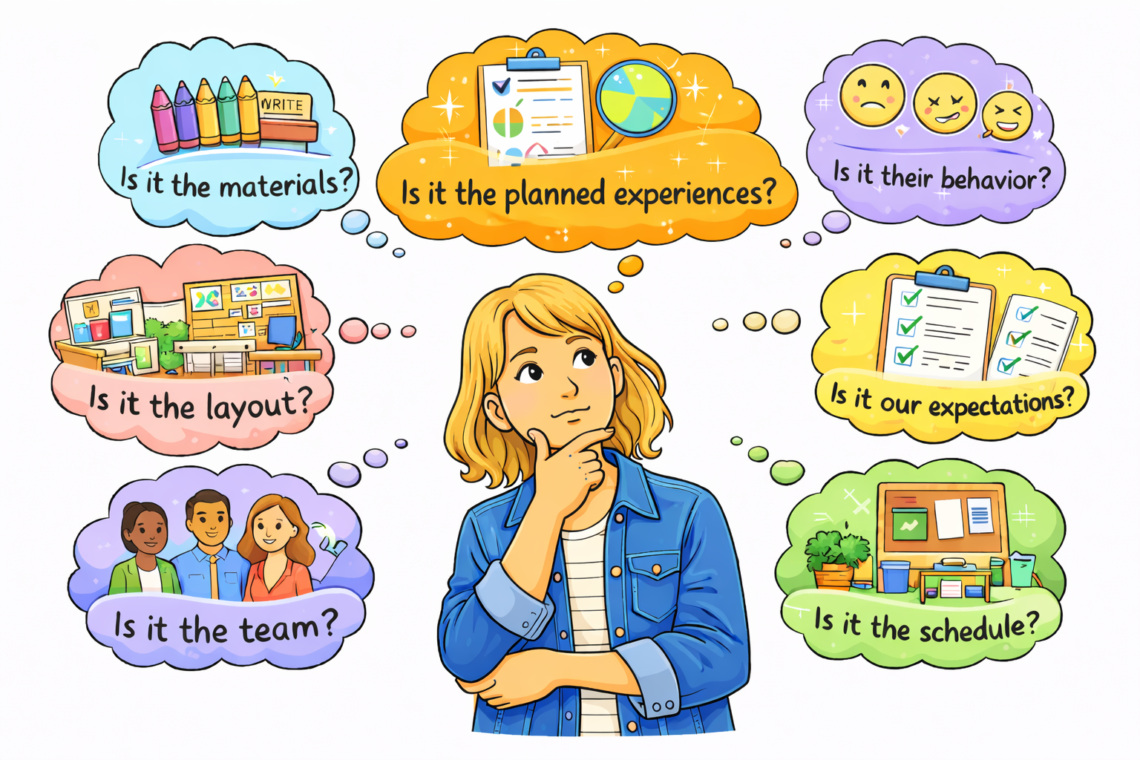
When I hear teachers say that children are not engaged because we don’t have this or that — more materials, different centres, a bigger space — I understand where that thought comes from. The environment does matter. The layout matters. What we offer children matters.
But it is never just that.
In my last post, I spoke about how we view behaviours in the classroom. That lens alone can change the tone of a day. The same room, the same children, the same materials — and yet a completely different experience depending on how we interpret what is happening in front of us. One day feels manageable. The next feels like you need a degree in conflict resolution and a nap.
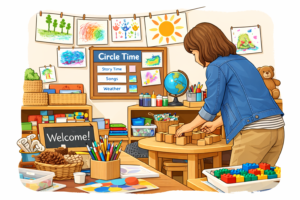
Most of us in Early Childhood Education carry a vision of how a classroom should operate.
We picture what should be in it.
How it should look.
How children should move within it.
How they should interact with materials — and with each other.
And ideally, everyone remembers to refill the paper towel without being asked.
When I first entered the field after finishing university — having completed only one ECE module — I quickly realised that theory and practice are very different experiences. I walked into classrooms and had to learn why things were arranged the way they were. Why certain materials were accessible and others rotated. Why some educators were very structured and others more fluid — something you do not learn in an ECE course.
It depends, of course, on the curriculum or framework you follow. It depends on what you believe benefits children most.
Over the years, I’ve had the opportunity to work within several approaches — Montessori, Reggio-inspired environments, emergent curriculum, movement-based learning, structured frameworks. And here is what I have come to understand:
There is no one right way.
There are principles. There are philosophies. There are research-backed strategies.
But there is no universal formula that works in every classroom with every team and every group of children. There is no magical setup that guarantees harmony between 35 small humans and 4 adults who are also trying to remember if they defrosted dinner.
Because everyone is different. Educators bring their own backgrounds, experiences, strengths, insecurities, habits — and occasionally their own need for control. Children arrive with their own interests, cultural contexts, developmental needs, and very strong opinions about fairness.
So the real question becomes:
How do we make all of those differences fit together in a way that feels strong?
A strong classroom isn’t found. It’s formed.
When I think about a successful classroom now, I no longer picture a perfectly organized environment. I don’t imagine a day where everything runs smoothly or where every child is constantly engaged.
I think of something else.
Vision.
Team.
Communication.
Flexibility.
Understanding.
And not being fixed about things that, if we are honest, will not matter by the end of the week — even if they feel urgent in the moment.
That last one can be uncomfortable.
Sometimes we hold the line over the smallest things. And sometimes we let go of the things that actually needed clarity. That balance is not taught in textbooks. It is learned in practice. Because sometimes what we defend most passionately is not what actually impacts children most deeply.
Through observation — and many conversations with educators who have shaped my own growth — I have noticed something else. At times, what looks like lack of motivation or resistance to change may actually be something different. We often label it as unwillingness, bias, or lack of passion.
But I have started to question that.
What if it is the same dynamic we see with children?
When a child struggles to follow a routine or adopt a new skill, we say,
“They might not know how yet.”
When a child struggles with a routine, we scaffold.
When a child resists a new expectation, we model.
When a child cannot regulate yet, we support.
At least, I hope we do.
But when an adult struggles to shift perspective, adopt a new approach, or adjust long-standing habits, we sometimes assume they should just know how to see it the way we do.
“Well, if I understand this, why don’t they?”
The truth is — knowing how to see differently takes practice. Knowing how to work in new systems takes support. Knowing how to let go of old habits takes time.
A successful classroom, most of the time, is not built because everyone walks in already aligned. It is built because people are willing to learn how. That includes children and it includes us (Though sometimes the hard truth is that not everyone is willing — and that is part of the work too).
Over the next few weeks, I want to unpack what “successful” really means to me — not in theory, but in lived experience.
The role of shared vision.
Why strong teams matter more than beautiful shelves.
Why asking for help is not weakness.
Where flexibility saves your sanity (and possibly your voice during winter gear season).
And how sometimes the most powerful decision of the day is choosing not to die on that particular hill.
Because a strong classroom is not accidental.
It is intentional.
It is built slowly.
And most of the time — it is still a work in progress.
Behind the Crayons, strong classrooms aren’t built in a day — and they’re certainly not perfect.
They’re built in the trying… and then trying again.
— The Teacher Behind the Crayons
💬 I’d love to hear from you! Have you had a “pause and breathe” moment with your little learners? Or maybe a funny story about a fire drill and a glitter explosion? Share your thoughts, questions, or classroom wins in the comments below—let’s keep the conversation going.
Discover more from Behind The Crayons
Subscribe to get the latest posts sent to your email.
Who is this really challenging?
You May Also Like
The Teacher Behind The Crayons
June 18, 2025
Emotional Intelligence: Teaching children about Self- Awareness
June 20, 2025