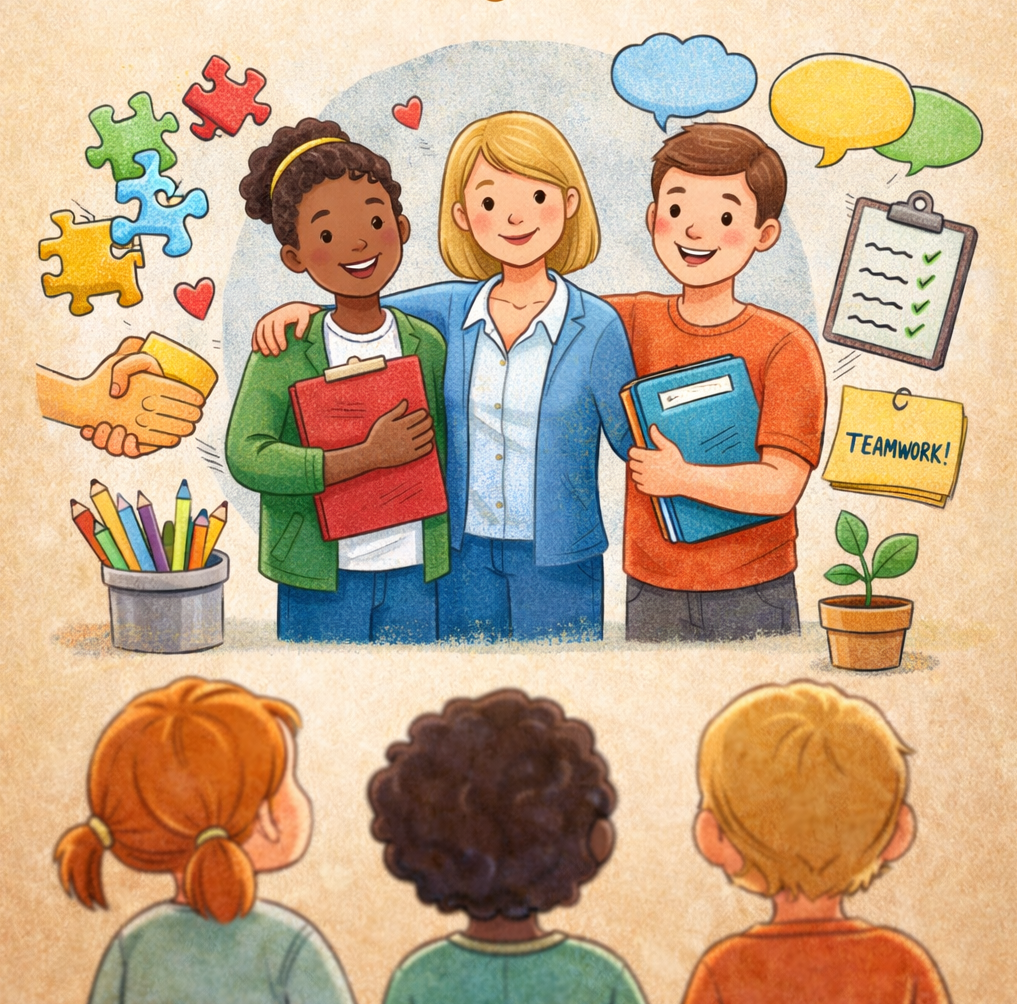
My Successful Classroom (Most of the Time): Strong Teams Build Strong Classrooms
In this series, I’ve been reflecting on what actually makes a classroom feel strong — not in theory, but in the messy, everyday reality of working with children and the adults around them.
In the last post I wrote about vision. About how systems alone don’t hold a classroom together if the people in the room aren’t aligned around what really matters.
But shared vision is only the starting point.
Because vision might tell us where we want to go, but it’s the people in the room who determine whether we actually move in that direction together.
And that’s where the next piece comes in.
The team.
Of course, every team and every centre is different. The cultures, the personalities, the leadership styles — all of it shapes how a classroom functions.
What I’m sharing here isn’t a formula for what every team should look like. It’s simply the path that helped me understand the role a team plays in a strong classroom.
My understanding of teamwork — and my place within it — didn’t appear overnight. It evolved slowly through experience, reflection, through the uncomfortable moments that forced me to rethink how I was approaching leadership, and sometimes through the kind of classroom moments that make you question everything you thought you had figured out.

There was a season where I believed that if I just stayed one step ahead of everything, the classroom would feel strong.
I would arrive early to set up provocations. Reset shelves before anyone noticed they needed resetting. Mentally map transitions so they flowed smoothly. When winter transitions to outside felt chaotic, I started to organise the gear into order beforehand. If documentation was falling behind, I completed them in my own time at home. Because apparently “balance” was something I talked about more than I practised.
It felt responsible. It also meant that, slowly and almost invisibly, I was carrying more than I realised. No one asked me to. But no one stopped me either. Apparently I had decided that being three steps ahead of the room was a personality trait. And over time, a pattern formed.
If I was there, the room would run smoothly.
If I stepped out, things felt heavier.
I wore that like a badge of honour for a while and at the time, I didn’t notice what it was doing to me.
When you keep stepping in, staying late, fixing the small things before anyone else notices them, it doesn’t feel like too much. It just feels like doing your job well. But slowly, the line between being responsible and being responsible for everything begins to blur. At first, I interpreted that pattern as proof that I was doing my job well. Later, I began to wonder something else.
If a classroom only feels stable when one person is present, is it actually stable?
That question stayed with me longer than I expected.
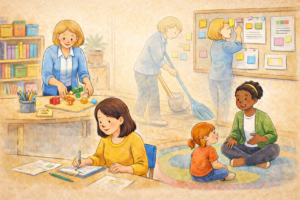
I remember one particular morning during winter transition. Snow pants everywhere. Boots half on. One child was already melting down because their mitten was “the wrong one”(which looked suspiciously identical to the one already on their other hand). I was moving quickly — lining up gear, redirecting energy and stepping into small conflicts.
And somewhere in the middle of all that movement, a small realisation slipped in. I hadn’t actually asked anyone for help. I had just assumed it was faster to do it myself.
Faster, yes. Sustainable? Not so much.
But the real problem in that moment wasn’t that no one else stepped in.
In our classroom, like in many others, each educator often supports their own group of children through transitions. Most of the time, we’re each managing our small corner of the room.
The problem was that I carried the struggle silently. I didn’t pause to say, “This part feels tricky today” or I didn’t ask, “Have you found a way to make this transition smoother?”
I’m fairly certain most educators have had those questions pass through their minds at one time or another.
I just never said them out loud and I just kept moving.
And that’s something I’ve come to see differently over time.
Because strong teams aren’t built by everyone jumping in to solve every difficult moment. The team strength often comes after the moment — through reflection and shared learning — not necessarily through five adults trying to solve the same snow-pants situation at the same time.
Sometimes what actually strengthens a team is simply talking about the moment afterwards.
What felt hard, what worked and what didn’t.
Sometimes another educator notices a pattern you hadn’t seen yet or helps you see a child’s behaviour from a different perspective. And sometimes the biggest relief is realising you weren’t the only one who found that moment difficult.
That kind of conversation creates something important in a team — psychological safety. The understanding that it’s okay to say, “This part was hard,” without feeling like you’ve failed.
But that reflection is only one side of teamwork.
The other side is something much quieter.
It’s the small moments when someone notices what needs doing and simply does it — resetting a centre without being asked, stepping into a conversation when they see your tone shifting, preparing winter gear before it turns into a negotiation, or starting documentation because it matters, not because it’s being checked.
Those moments are not dramatic and don’t usually come from instructions. They change how a room feels and come from shared ownership of the room.
Strength doesn’t grow when one person compensates for everyone else. It grows when responsibility is shared — even if that means it takes a little longer in the beginning.
And shared responsibility is not automatic. It’s practised in the small things.
I’ve also worked in centres where turnover was frequent. Management changed, the staff rotated and with that expectations constantly shifted.
You can feel the difference almost immediately.
Children test boundaries again — not because they’ve suddenly “forgotten,” but because relationships have shifted. Emotional safety has to be rebuilt. Adults are learning each other’s rhythms while trying to appear steady.
And turnover rarely appears out of nowhere.
Sometimes it happens because the classroom itself doesn’t feel sustainable — expectations are unclear, the workload feels uneven, or the team never quite finds its rhythm. Other times it grows from something deeper in the culture of the centre.
How educators are supported.
How much trust they are given.
Whether their professional judgement is valued or constantly questioned.
I’ve experienced that side of it too.
There have been moments in my career when I chose to leave not because I stopped caring about the work, but because the environment around it made the work harder than it needed to be. When leadership becomes micromanagement, or when educators feel unseen in the decisions that shape their classrooms, even the most committed people eventually begin to look elsewhere.
Research confirms what we already sense in those moments. High classroom staff turnover is associated with disrupted attachments, lower classroom quality, and reduced social-emotional and academic outcomes for children. It often increases behavioural challenges because consistency disappears (Vicente, Venegas & Guerrero, 2025).
But honestly, you don’t need the citation to recognise it.
You can see it when a child clings a little tighter to the educator who remains.
You can feel it when routines take longer because adults are still figuring each other out.
Turnover doesn’t just disrupt scheduling. It disrupts trust.
And trust is what allows collective ownership of the classroom to grow.

Even without turnover, imbalance can exist quietly inside a “stable” team.
Sometimes one person becomes the planner.
One becomes the behaviour holder.
One becomes the organiser.
One absorbs the emotional tension.
It doesn’t always happen intentionally. Sometimes it grows out of strengths. Sometimes it grows out of silence. That’s not teamwork. That’s a silent hierarchy — and silent hierarchies have a way of getting loud eventually. Over time, that can lead to resentment or burnout, even if no one names it.
I had to recognise that my own competence was unintentionally limiting other people’s growth. If I always stepped in, others didn’t get the chance to struggle through and build their own rhythm. That didn’t mean I suddenly stopped supporting people and just watched the struggle unfold like some sort of professional development experiment. It meant the support looked different.
Instead of stepping in to fix the moment, I tried to step alongside it.
Sometimes that meant asking questions or offering a different strategy. Sometimes it meant widening the lens a little.
“What do you think might be underneath that behaviour?”
“Could we try approaching it this way instead?”
“Is this one of those moments where we might not need to die on that hill today?”
Often the struggle wasn’t about the immediate situation at all. It was about perspective.
Sometimes it was about remembering that behaviour has a reason. Other times it meant stepping back far enough to see the bigger picture of the day instead of the frustration of the moment. And the more I reflected on it, the more I realised something slightly uncomfortable — the same lens I try to use for children had to apply to adults as well.
If behaviour is communication for children, then hesitation, frustration, or resistance in adults might be communicating something too. Which brought me back to a thought I had earlier in this series — sometimes people simply don’t know how yet.
Apparently emotional development doesn’t stop at age five. Who knew.
Like many things in education, that idea is much easier to explain during training sessions than it is to practise on a busy Tuesday morning. And just like with children, growth rarely happens because someone else solved the problem for us. It happens when we are supported enough to think our way through it.
If I always carried the vision, no one else had the chance to practise holding it. And practice is where capacity grows — through trying, through getting it slightly wrong, and through being trusted enough to try again.
Leadership began to look different to me after that.
Less about being the most capable person in the room and more about making sure capability was distributed.
It was about transparency — explaining why I make certain decisions instead of just making them. Inviting others into planning instead of presenting finished ideas and being okay when something was done differently — even if my first instinct was to “adjust it.”
That one still challenges me. Especially on days when I’m convinced my way is the efficient way.
Stepping back, however, doesn’t automatically create growth.
I learned that the hard way too.
You can create space.
You can invite someone into leadership.
You can say, “You take this one.” And then sit on your hands so you don’t jump in five minutes later.
But if there isn’t willingness on the other side — if there isn’t curiosity, reflection, or the readiness to try again when it feels uncomfortable — nothing really shifts.
Shared responsibility requires shared effort.
Growth in a team is not something that happens to us. It’s something we participate in. And sometimes, when you step back and allow space, what’s revealed isn’t chaos — it’s clarity.
Clarity about who wants to grow.
Clarity about who is ready to try.
And sometimes, clarity about fit.
That doesn’t make anyone wrong. It just makes alignment visible.
Just like children, adults don’t grow simply because opportunity exists. They grow when they practise and reflect. When they’re willing to sit in the awkward middle of not knowing yet. If we expect children to grow, to practise, to try again — then we cannot exempt ourselves from the same process.
That’s where continuous learning matters. Not as a checkbox way but as a mindset.
Workshops. Webinars. Conversations that challenge our thinking. Even the ones scheduled on evenings when you’d rather be in pyjamas. Reading something that makes you uncomfortable in a productive way.
Knowledge isn’t about collecting certificates. It’s about expanding perspective. It gives us language for what we feel but can’t yet articulate. It gives us options and tools to guide differently, and the ability to reimagine what we thought was fixed.
Throughout my career, professional growth has been approached differently in each centre. In most places, yearly one-to-one meetings were held between management and staff. In my current role, I’ve been given the opportunity to have additional one-to-one conversations directly because I see the day-to-day reality of the classroom. At first, that felt intimidating. But it became something else.
Those meetings stopped being evaluations and started becoming bridges.
Instead of asking only, “Are expectations being met?” I began asking, “How can I support you better? Where do you feel stuck? What do you need from me?”
And sometimes, I had to ask myself, “Are my expectations realistic? Or are they moving faster than the room?”
Because if I expect my team to reflect, I have to be willing to do the same.
But willingness has to go both ways.
Meeting my staff where they are — instead of waiting for them to meet my expectations — has been one of the biggest shifts in my leadership.
And if I’m honest, sometimes those expectations were too high. Not because I wanted perfection. But because I wanted progress quickly.
Strong teams don’t grow because one person sets the bar high. They grow because everyone agrees to lift together. Not by adding more to the day. But by carrying it differently.
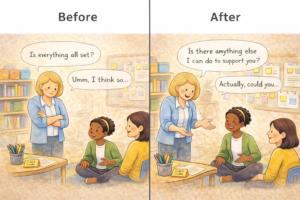
The strongest days in the classroom are not the days when everything runs perfectly.
They’re the days when support feels natural. When someone steps in before being asked. When communication feels open instead of guarded. When no one feels like they have to carry the weight of the room silently.
They’re the days when people feel safe enough to say, “That moment was hard,” and curious enough to reflect on it together.
When small things are noticed and taken care of without needing to be assigned. When responsibility is shared, not because someone said so, but because the room belongs to everyone in it.
Those are the days when the classroom begins to feel steady.
But that kind of steadiness doesn’t happen by accident. It requires something from all of us — a willingness to grow, to reflect, and sometimes to rethink the way we’ve always done things.
For me, that meant shifting the way I understood leadership. Less about holding everything together myself and more about creating space for others to grow into it too.
Not flawless.
Not effortless.
But steady enough that no one is quietly drowning behind a calm-looking classroom.
Because sustainability in a classroom isn’t about doing more.
It’s about not doing it alone.
And occasionally remembering that strong teams are built through reflection and shared learning — not necessarily through five adults trying to solve the same snow-pants situation at the same time.
Behind the crayons, strong classrooms aren’t built in a day — and they’re certainly not perfect.
They’re built when no one carries the room alone.
— The Teacher Behind the Crayons
💬 I’d love to hear from you! Have you had a “pause and breathe” moment with your little learners? Or maybe a funny story about a fire drill and a glitter explosion? Share your thoughts, questions, or classroom wins in the comments below—let’s keep the conversation going.
References
Vicente, D., Venegas, M., & Guerrero, A. D. (2025). Turn-over and retention among Head Start educators. Early Childhood Education Journal, 53, 1467–1478. https://doi.org/10.1007/s10643-024-01685-x
Discover more from Behind The Crayons
Subscribe to get the latest posts sent to your email.

You May Also Like
The Teacher Behind The Crayons
June 18, 2025
A Lap, A Leak, and the Importance of Emergency Underwear
June 23, 2025