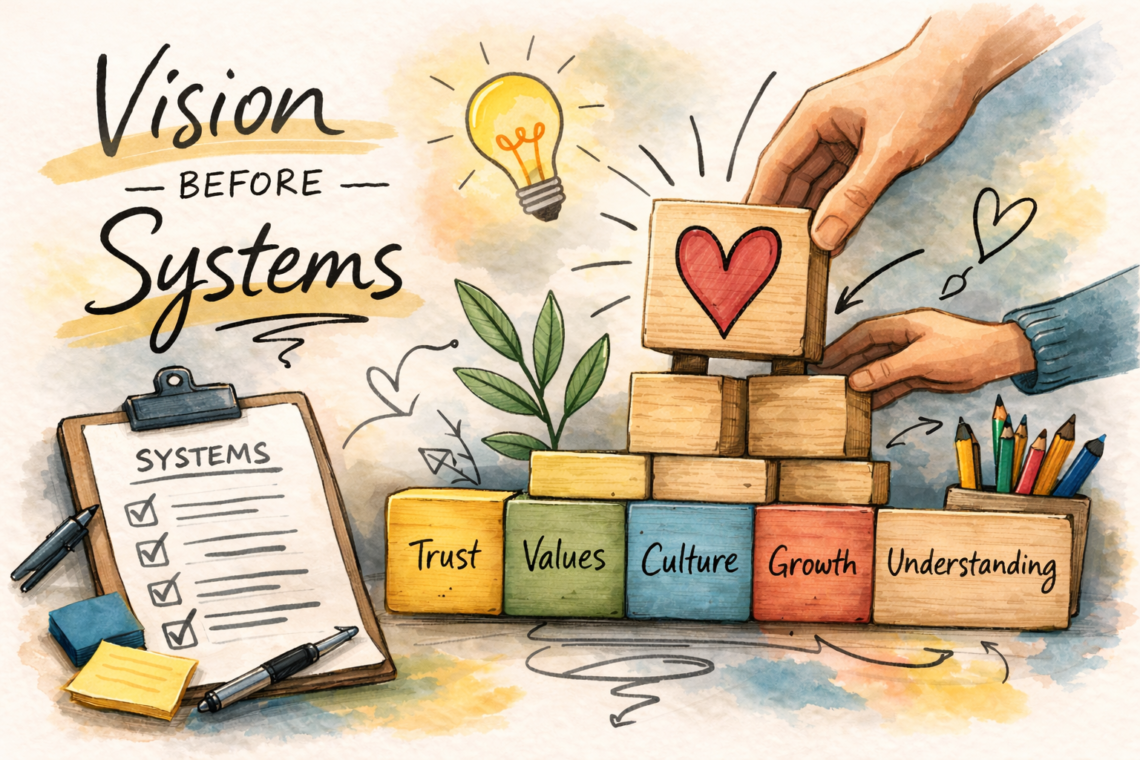
My Successful Classroom (Most of the Time): Vision Before Systems
Before I go any further, I should probably explain what I mean by “systems” and “vision,” because I used to think they were almost the same thing.
When I say systems, I mean the structure we are trying to implement when things feel messy such as the schedules, roles, duties checklists, clearly written expectations and the clipboard that makes you feel like at least something is under control (even if everything else clearly is not).
And when I say vision, I don’t mean a laminated philosophy statement on the wall.
I mean a shared understanding of what matters most in the room — especially when things don’t go according to plan. What we prioritise, hold firm on, let go of. How we see behaviour, define safety and what kind of culture we are trying to build together.

When I first started making changes in the classroom, I leaned hard into systems.
It felt sensible, productive, measurable. It looked like leadership.
We clarified expectations, changed the classroom layout and introduced defined roles. I created end-of-shift checklists and tightened up the daily schedule so transitions made more sense. It felt like progress. There is something deeply reassuring about a checklist. It gives you the impression that if you organise things clearly enough, everything else will naturally fall into place.
And to be fair, it did help. The room felt calmer. The layout worked better. Materials were easier to manage instead of multiplying overnight like they sometimes do. On the surface, things looked stronger.
But looking back, I can say this honestly — it wasn’t strong yet.
About six weeks into the position, I went on a holiday that had been planned long before I even applied for the job. I left feeling cautiously confident. There was a plan in place. The systems were written down. I had someone to step into a guiding role while I was away. We had conversations beforehand. We talked through expectations and mapped out what leadership could look like in our classroom.
I genuinely believed we were aligned.
In my head, I had already mentally ticked that box. Turns out, alignment is not a box you can tick once and move on from.
When I returned two weeks later, the systems were technically still there — but something felt off. The structure hadn’t held the way I expected it to. It wasn’t dramatic. It wasn’t chaos in the movie-scene sense. It was subtler than that. The clarity we had worked toward felt like it had softened around the edges.
I remember thinking, We talked about this. We agreed on this. Why does it feel like it doesn’t belong to everyone?
If I’m honest, underneath that confusion was something else. Loneliness.
I felt like I was carrying the direction of the room by myself. Like I was the only one pushing the shift forward. And at the time, I told myself that meant I just needed to tighten things up more. Because obviously the solution to misalignment is another checklist (Or so I thought).
Looking back, I can see that part of that loneliness came from assuming my way was the way. I thought if we just tightened expectations, ticked the boxes, and held everyone accountable, everything would improve. I was still very attached to the idea that structure makes everything better.
What I didn’t see yet was that I also needed to grow.
I was trying to lead the way I had seen strong leaders lead. I admired my mentors deeply, and without realising it, I was trying to become a version of them. What I hadn’t figured out yet was how to become my version of what I had learned from them.
And in doing that, I was moving faster than the room.
Structure does not create ownership.
Assigning a leadership role does not automatically create shared understanding.
Writing expectations down does not mean they have been internalised.
What I slowly realised was that we had systems — but we did not yet have shared vision.
I saw leadership as holding the group together and creating space for others to grow into their strengths. I learned that leadership can mean very different things to different people. Not wrong — just different. And without a shared understanding of what we were building and why, the systems became something to follow rather than something to believe in.
The director and I tried to scaffold growth. We had more conversations. We made plans. We offered support. But growth cannot be forced. Alignment cannot be imposed.
And just like children, adults thrive in different environments. Sometimes it isn’t about competence. Sometimes it’s about fit.
That realisation was uncomfortable.
Because it meant the issue wasn’t the checklist.
It was the pace.
I had layered the structure before ensuring we were aligned in purpose. I thought progress meant tightening systems quickly. I thought clarity would naturally create culture.
Instead, I learned — gradually, and not without resistance — that culture creates systems, not the other way around.
That doesn’t mean systems don’t matter. They absolutely do.
Before we had clearer expectations and rotating end-of-shift checklists, many of the small but important things didn’t happen consistently. Not because people didn’t care. Often it was simply because they hadn’t been shown to look for those details yet.
What we often call common sense is usually learned through repetition and exposure. It’s learned awareness.
I didn’t always realise that.
To me, it felt obvious that you reset a provocation before lunch instead of leaving it for someone else to clean up. That you line up winter gear before transition so you’re not negotiating sleeves and boots with twenty impatient children. That you put shelves back intentionally after centre time instead of loosely “tidying.” That you prepare tomorrow’s experience the day before instead of scrambling in the morning while pouring your second coffee.
But obvious to me didn’t automatically mean obvious to everyone else — and that didn’t mean they cared less. It meant they hadn’t practised noticing yet.
And that was a humbling realisation.
None of those things are dramatic. They won’t make it into a glossy Instagram post about classroom transformations. But they quietly change the flow of a day. They prevent small frictions from becoming big frustrations. They make the room feel held — even when it’s busy.
And unless someone has been exposed to that way of thinking — unless they’ve seen how those small resets prevent larger stress later — they don’t automatically feel urgent.
That’s where systems helped. Not as control. Not as criticism. But as clarity.
They made the invisible visible. And they gave everyone a chance to practise noticing.
Over time, we practised those habits through the rotating checklists. And just like we do with children, repetition built awareness. We don’t expect a child to regulate emotions or transition smoothly the first time. We practise. We repeat. We scaffold.
Adults are no different. We just like to pretend we are.
Eventually, the lists weren’t something we had to check. They had become part of how we moved through the room. The goal was never the checklist. It was building the habit of thinking one step ahead — for ourselves and for each other.
One piece of advice from my director has stayed with me ever since: “Don’t implement something new until they’re ready.”
At the time, I heard it as a strategy. Now I understand it as emotional maturity.
Readiness is not about capability. It is about alignment. It is about whether people understand the “why” behind the change. Whether they feel part of the direction instead of managed by it.
Shared vision didn’t start with another checklist. It started with conversations. Slower ones. About what we valued, what we were willing to hold firm on and what we were not going to let define our day. About behaviour guidance, autonomy and what safety actually meant in our space. I had to learn to meet the adults in the room where they were — not where I wanted them to be. Just like we do with children.
So I changed my question.
Instead of asking, What can we improve next? I started asking, What are we ready for?
That shift slowed everything down. And oddly enough, that’s when things became stronger. Not perfect. Not effortless. But shared. Slowing down wasn’t a delay. It was alignment. It just didn’t feel that way at first.
Vision is not a poster on the wall. It is a shared agreement about what matters most — especially on the hard days.
Before adding another checklist, another system, another improvement plan, maybe the quieter question is this:
Are we building structure, or are we building shared vision?
Behind the Crayons, strong classrooms aren’t built in a day — and they’re certainly not perfect.
They’re built when we slow down enough to build them together.
— The Teacher Behind the Crayons
💬 I’d love to hear from you! Have you had a “pause and breathe” moment with your little learners? Or maybe a funny story about a fire drill and a glitter explosion? Share your thoughts, questions, or classroom wins in the comments below—let’s keep the conversation going.
Discover more from Behind The Crayons
Subscribe to get the latest posts sent to your email.

You May Also Like
My Career Reflection
January 26, 2026
The Teacher Behind The Crayons
June 18, 2025