Peace of Mind Curriculum
If you’ve spent some time reading my earlier posts, you may already have a sense of why this blog exists. If not, I thought it might be time to say it out loud.
This blog grew out of my practice—years of observing children, reflecting on my own teaching, and learning (sometimes the hard way) what truly matters in the early years. Again and again, my experience has shown me that focusing on children’s social and emotional development is far more important than prioritising academic learning during early childhood.
Research supports this, but honestly, so do the children. When emotional intelligence—things like self-regulation, empathy, social skills, emotional awareness, and motivation—is still in the early stages of development (all areas I’ve explored individually in previous posts), learning other skills becomes much harder. Difficulties with identifying or managing emotions often show up as challenges with relationships, classroom behaviour, and eventually academic performance (Tominey et al., 2017).
Before children can meaningfully engage with letters, numbers, or expectations, they need to feel safe, understood, and emotionally supported. Learning simply doesn’t thrive when a child’s nervous system is overwhelmed.
One very awesome tool I want to share with you is the Peace of Mind curriculum (you’ll find a link to their website in the reference section). I was introduced to this curriculum over five years ago, and I truly can’t emphasise enough the positive impact it has had on children’s wellbeing and their ability to thrive in early learning environments. I also want to take a moment to express my heartfelt gratitude to Linda Ryden, the founder of the Peace of Mind curriculum, and Jelena Popovic, Partnerships and Programs Manager, for generously giving me permission to share the structure of the curriculum and some of the accompanying images here. I am deeply thankful for their trust and support.
I wanted to introduce it properly here because it will come up often in future posts and classroom stories—and I’ve already mentioned it in passing before. One of the things I appreciate most about Peace of Mind is how accessible it is. Every lesson comes with a clear, scripted guide for educators, which can be incredibly reassuring, especially when you’re starting something new. That said, the script is not a rulebook. It’s an invitation. You are encouraged to adapt it, adjust it, and make it work for the children in front of you.
Peace of Mind Curriculum
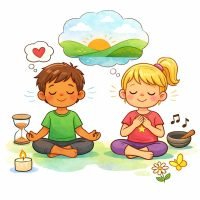
Peace of Mind Curriculum is a mindfulness-based social and emotional learning program designed to help young children self-regulate, strengthen social skills and increase self-esteem. The curriculum includes three critical and interwoven components: Mindfulness, Social and emotional learning, Kindness and partner practice.
Mindfulness
Every lesson begins with mindfulness practice. Since this is most students’ first introduction to mindfulness, the concepts are taught slowly, gently, and with repetition.
The mindfulness sessions are intentionally short initially, and gradually grow to a minute or more by the end of the curriculum. Given the relatively short duration of each session, mindfulness practice for Early Childhood students is referred to as a Mindful Moment.
The way I have witnessed children’s ability to focus and intentionally think about different concepts grow has been fascinating. A mindful moment is such a powerful way to teach children to slow down. We all know our minds can race a hundred miles an hour—and children’s minds often move even faster.
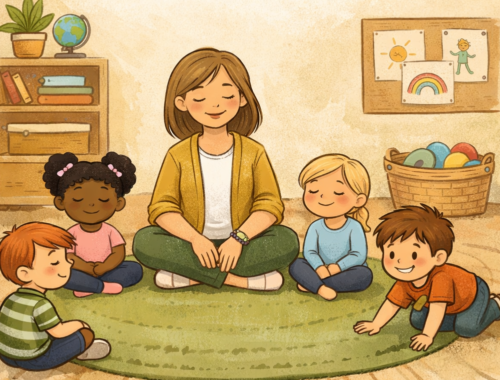
Let me paint you a picture. Imagine a child who finds stillness really challenging. Every sound, light, or physical sensation pulls their attention elsewhere (and there are many children like this—and it’s completely normal). When I first introduce Peace of Mind mindful moments to a new group, I see a lot of movement, chatter, and curiosity about everything else. And honestly, who truly enjoys sitting still at the age of three to five?
But with short, consistent practice, something beautiful begins to happen. Over time, I see children learning how to slow their bodies and minds. I see them squeezing their eyes shut as they focus on a special person they want to send kind thoughts to—one of the activities in the curriculum—and later sharing those thoughts with the group.
At first, many children repeat each other’s answers, but gradually their own original ideas emerge. As their ability to focus strengthens through these mindful moments, so does their confidence in expressing themselves.

Mindfullness Skills
The mindfulness skills taught in this curriculum are designed to build from week to week, moving from simple deep breathing to cognitive regulation strategies. Here is some of the examples of the mindfulness skills that are taught in this curriculum:
Mindful body position Flower breaths Take 5 breaths
Body scan Visualisation Squeeze & Release
Heartfulness Gratitude Heartfulness for self
Amazing me Affirmations Positive self-talk/problem solving
Mindful seeing Mindful hearing Mindful touch
Mindful smell Mindful taste
![]()
Week after week, I see more children becoming engaged—and for longer periods of time. I see them beginning to take ownership of their bodies and emotions, essentially training themselves to become more resilient, calmer in challenging situations, and more intentional in how they react.
They become more present in the classroom and more aware of both themselves and those around them. One of my favourite moments is when children begin using these strategies outside of our Peace of Mind sessions. Parents often share that their children are practising these skills at home, and sometimes the children even remind us, the educators, to use them when our own bodies need calming (which is fantastic!).
Social and Emotional Learning
Every lesson contains a Social and Emotional Learning (SEL) component. These lessons involve puppets, stories, and games to illustrate the skills taught. The SEL components of each lesson are grouped into six units that follow the rhythm of a traditional school year and the interpersonal development of young children. Each lesson is also interwoven with the mindfulness skills listed above, and each mindfulness skill helps reinforce the SEL topic.
This is a sequential list of the unit topics:
- Mindful Bodies, Mindful Breaths
- Mindful of My Thoughts and Feelings
- Mindful of Others
- Feeling Good About Myself
- Mindful Problem Solving
- Mindful Senses & My Growing Brain
![]()
I am continually amazed by how exploring these topics empowers children to solve their own problems with greater ease. They gain a deeper understanding of their ability to self-regulate in challenging situations, and I can see their confidence in themselves grow.
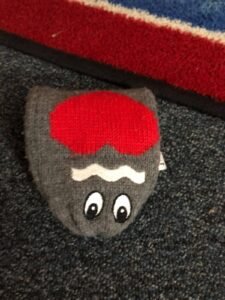
All of the educators in my classroom use the Peace of Mind vocabulary beyond the sessions, helping children connect their real-life experiences back to the strategies and lessons learned during Mindful Moments, puppet shows with Brainy and Paco and discussions in Kindness Pals.
(You can order the puppet Brainy (picture above) or make one yourself. You can use any other puppets too to help model different scenarios. My kids have loved choosing different ones and give them very creative names)
Kindness Pals
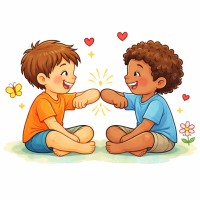
The final component of each lesson in this curriculum, starting in the second unit, is Kindness and Partner Practice, also simply known as “Kindness Pals.”
Kindness Pals is an engaging activity that achieves several goals:
- Reminding the children to make kindness part of their daily lives.
- Doing kind things for their Kindness Pals spills over into their treatment of others.
- Developing the habit of treating people with kindness through regular practice.
- Giving children opportunities to get to know each other and to “find the good” in others whom they might not have gotten along with in the past or whom they think they just don’t like.
![]()
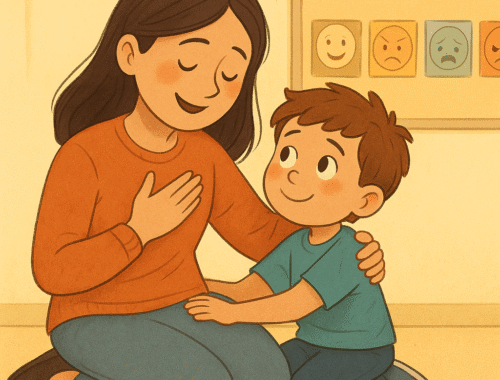
When children sit criss-cross, knees touching knees, they are physically very close to one another—and for some, that can feel uncomfortable. Honestly, it can feel uncomfortable for us adults too. But the more we practise, the easier and more natural it becomes.
What I truly love about Kindness Pals is how it gently brings children together who might not naturally gravitate toward each other in the classroom. It also creates beautiful opportunities for older children to support and guide younger ones, as partners are swapped weekly. These moments build empathy, patience, and genuine connection in such an organic way.
When I first received the Peace of Mind book, I’ll be honest—it felt daunting. There was a lot of information, and just as many questions from colleagues: How will we do this? When will we fit it in? Why this, on top of everything else? It felt overwhelming. And at first, the children didn’t respond to the lessons the way I had hoped.
But that didn’t make me stop.
With feedback from my supervisors—and from the children themselves (which, as you can imagine, was rarely verbal and often very honest)—I began adjusting the flow and delivery of the curriculum. That’s the key part right there: following the children’s interests, needs, and abilities.
Peace of Mind was a completely new addition to our daily rhythm. Over the years, the sessions have taken place during morning gatherings, early afternoons, late afternoons—wherever they fit best. I’ve adapted it across different centres, classrooms, age groups, and daily schedules.
Interestingly, although several educators across more than ten centres were given the curriculum to explore and implement if they wished, I ended up being the only one who consistently used it. That said, I’ve been fortunate to bring it with me wherever I’ve worked. The educators I’ve collaborated with over the years have shown growing interest and a deeper understanding of just how beneficial this work is for children.
You may remember the classroom story about Daniel in “I See You – A Story About Slowing Down and Looking Closer.” The strategies I introduced there came directly from the Peace of Mind curriculum. The way the curriculum is structured allows children to start small—building foundational skills first—and then gradually deepen their understanding. That’s exactly how Daniel learned, and how we learned together.
Another thing I deeply appreciate about Peace of Mind is how flexible it is. You are in charge of it. Some lessons may appear lengthy at first, but that’s when it becomes essential to tune into what the children actually need.
We all know that young children and sitting still don’t always go hand in hand—honestly, many adults struggle with that too. So why do we expect children to sit for long periods of time? According to the Brain Balance website, the average attention span of a two-year-old is around 4–6 minutes, while a four-year-old’s is closer to 8–12 minutes. When I first began, the lessons felt far too long, and children’s attention drifted quickly.
But this work takes practice. Practice, practice, practice.
That’s where you come in. Make it your own. Break lessons into smaller pieces. Let go of the idea that it has to look a certain way. And most importantly—make it fun. Joy is what keeps children engaged.
I want to share a story with you that shows just how capable children are of understanding concepts we often assume are “too complicated.” This one comes from a Peace of Mind lesson on the brain.
Peace of Mind in Practice: Learning About the Brain
At this point, we had already been practising mindful bodies and exploring breathing techniques, thoughts, gratitude, and teamwork. Then it was time to talk about… the brain.
The brain?! That sounds complicated, right?
Let’s see how complicated it really is.
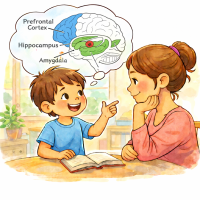
The curriculum introduces three parts of the brain:
The prefrontal cortex, responsible for decision-making
The hippocampus, which stores memory
The amygdala, which alerts us to danger (danger, danger, danger!)
Over several weeks, each part is explored in more depth through stories, discussion, and play. Puppets—Brainy (part of the curriculum) and Piggy (Puppet is called Paco in the book)—help model these concepts through engaging puppet shows. Children are fascinated.
One child—let’s call him Peter—a three-year-old preschooler, was especially intrigued. He eagerly participated in every session and loved sharing what he had learned with his peers during Kindness Pals.
One day, I received a message from Peter’s parents, along with a short video. It read:
“Hi, we wanted to share a video with you showing how excited Peter was to explain what he’s been learning about the brain.”
In the video, Peter sits at the table while his mum asks him about the brain:
Mom: “Can you tell me about the parts of your brain? What parts are there?”
Peter: “ One that is Hippocampus”
Mom:” Okay. Tell me about the hippocampus”
Peter: “ Yeh, that helps you rember”
Mom: “It helps you remember?”
Peter: “Yeah…Smoke or fire!”
Mom: “And what is it?”
Peter: “ It…..It’s.. It could be smoke or fire.. And Brainy… is the, is the, is the NEW stuffy. Ms (Teacher Behind The Crayons) used it today”
Mom: “To tell you what?”
Peter: “ To tell… me a… tell me about hippocampus and things, and things thaat, that kill you… or be… or be dangerous… but this isn’t dangerous”
Mom: “Noo. Okay, so there is the hippocampus and that helps you remember things?”
Peter: “Yeah.”
Mom: “What else is there?”
Peter: “This Amygdala (showing thumbs up with a hand).”
Mom: “The amygdala?”
Peter:” And it’s and it helps you to, to… to, to, to round and around and around in circle (making rounds with a finger up in the air)”
Mom: “Yeah?”
Peter: “Yeah, and then it’s a…. A… what is this called (pointing to his forehead?”
Mom: “What is it called?”
Peter: “I don’t know ah.”
Mom: “The pre-frontal…”
Peter: “Cotrex!”
Mom: ”Cortex. What does the pre-frontal cortex do?”
Peter: “ So… It helps you make a choice! If you want to go this way (pointing to his right) or this way (pointing to the left with his other hand).”
Mom: “Alright!”
Peter: “This means outside (pointing to his left)”
Mom: “Okay.”
Peter: “And this means inside (pointing to his right).”
When I spoke with Peter’s parents the following day to thank them for sharing the video, they told me how surprised they were—not only that he remembered the terminology, but that he was able to make meaningful connections and explain their functions. They admitted they had to look up the words themselves.
(A quick note about the fire and danger references: we use our thumbs to represent the amygdala. When it senses danger, it “flips up” and spins to show urgency. We talk extensively about real dangers—boiling water, fire, smoke, sharp objects, chemicals—as well as moments when our brain might overreact. Using puppets and play helps children understand both.)
Over the years, I’ve seen incredible changes in children who engage with this work. They learn strategies that are simple, accessible, and empowering—and they begin using them independently. Once children develop awareness of themselves, their feelings, and their needs, they show us just how capable they truly are.
In my opinion, the Peace of Mind curriculum—or any similar social-emotional practice—should be a foundational part of early learning. It offers children the opportunity to approach life and learning with calm curiosity rather than emotional overwhelm or inner struggle.
Some children grasp these concepts quickly. For others, it takes time—and that’s okay.
Be patient. Slow down. And keep practising.
If there’s one thing I hope you take from this, it’s this: children are far more capable than we often give them credit for—especially when we slow down enough to truly listen. When we make space for emotional understanding, curiosity, and connection, learning unfolds naturally. Not perfectly, not quickly, but meaningfully.
Whether you use the Peace of Mind curriculum or another approach that supports social and emotional development, I invite you to reflect on what children in your care might be asking for beneath the behaviour, the noise, or the resistance. Sometimes, peace of mind doesn’t come from having all the answers—but from being willing to pause, observe, and grow alongside them.
💬 I’d love to hear from you! Have you had a “pause and breathe” moment with your little learners? Or maybe a funny story about a fire drill and a glitter explosion? Share your thoughts, questions, or classroom wins in the comments below—let’s keep the conversation going.
References
Diesener, J. (2017). Peace of Mind Core Curriculum for Early Childhood: A Mindfulness-based Social and Emotional Learning Program Designed to Help Young Children Self-regulate, Strengthen Social Skills, and Increase Self-esteem. Peace of Mind Incorporated.
Tominey, S. L., O’Bryon, E. C., Rivers, S. E., & Shapses, S. (2017, March). Teaching emotional intelligence in early childhood. naeyc. https://www.naeyc.org/resources/pubs/yc/mar2017/teaching-emotional-intelligence
Peace of Mind https://teachpeaceofmind.org/
Normal attention span expectations by age. Brain Balance Achievement Centers. (n.d.). https://www.brainbalancecenters.com/blog/normal-attention-span-expectations-by-age#:~:text=1,old:%2016%20to%2024%20minutes
Discover more from Behind The Crayons
Subscribe to get the latest posts sent to your email.
My Career Reflection
You May Also Like
A Lap, A Leak, and the Importance of Emergency Underwear
June 23, 2025
Emotional Intelligence: Teaching children about Motivation
June 23, 2025