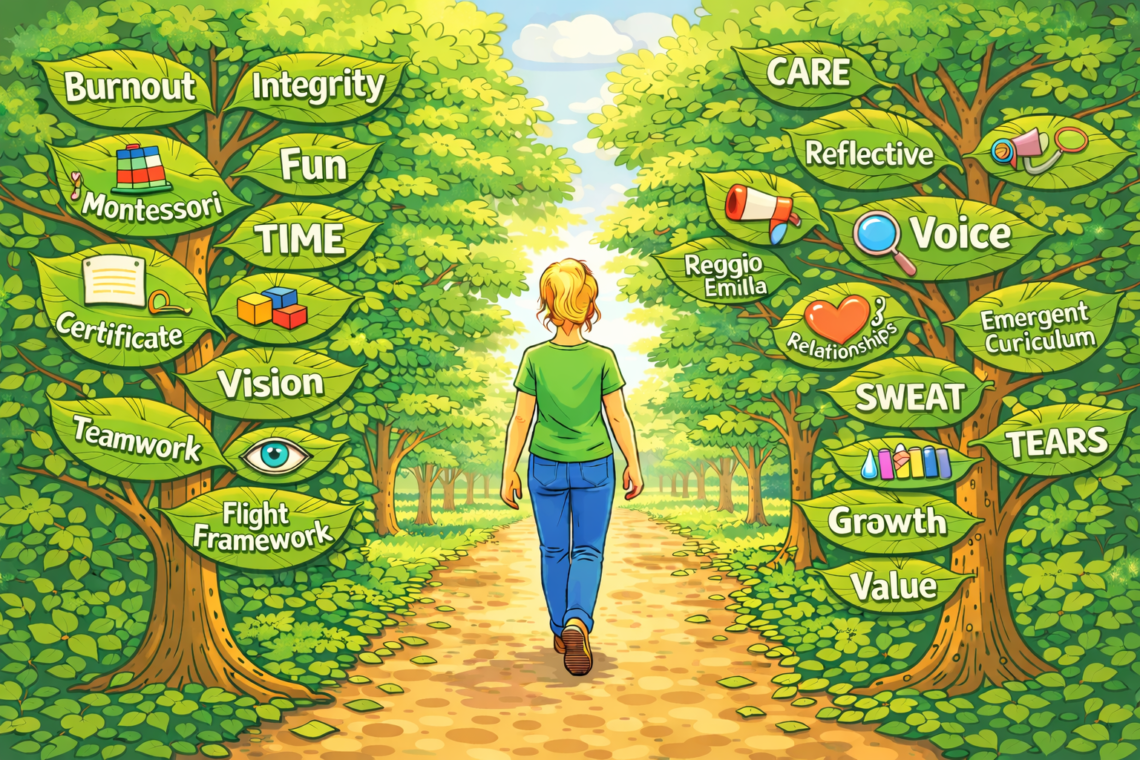
My Career Reflection
I didn’t enter early childhood education (ECE) with a five-year plan, a ladder to climb, or a list of titles I wanted to collect. I entered it because I was curious and I cared — about children, about learning, and about doing the work well, even when no one was watching.
Over the years, I’ve worked in very different centres, across countries, philosophies, and management styles. Some of them reminded me why I chose this profession in the first place. Others quietly taught me what happens when systems stop valuing the people who hold them together.
This isn’t a story about good centres versus bad ones. It’s a reflection on what we choose to prioritise in early childhood education — and what it costs when care, integrity, and respect become secondary to numbers, optics, and convenience.

When I started my career in ECE, I was lucky enough to begin in a centre that truly valued both children and educators. It was a three-classroom setting—infants, toddlers, and preschoolers—and I worked with the toddlers in a Montessori-inspired program. It was hands-on, play-based, and full of positive energy. I felt supported, encouraged, and seen. I was offered opportunities to grow and genuinely felt that educators were respected in the profession. Then an opportunity to move to another country came along.
With that foundation in mind, moving to a new country felt like a chance to grow — to learn, adapt, and bring my values into a different context.

That was quite not like that when I joined a much larger franchise—one of 11 centres across the city. At first, I felt welcomed and supported by the management. When I expressed concerns about being in a classroom that didn’t align with my philosophy (where children were told what to do and how, rather than guided through play- different way of applying Montessori teachings), I was moved to another room. That room was following Reggio Inspired teachings and I was excited to learn new concepts and ways to guide children’s learning. Unfortunately, interpersonal issues surfaced quickly. After a miscommunication between me and one of the co-lead teachers, she stopped speaking to me for two weeks. Professional? Not so much.
There was also a language barrier—surprisingly, not from me, but from educators with limited English working in an English-speaking childcare setting. It created real challenges in communication and collaboration. I raised these concerns with management and was eventually offered a preschool lead position.
Though it felt daunting, I took the role. I loved the children and was genuinely curious to learn about the physical education concepts that were emphasized in this setting. I appreciated the opportunity to grow professionally—deepening my understanding of the importance of physical education in the early years, while also learning to adapt to a different classroom schedule and overall flow.
Over time, however, I began to notice that the children needed more from the classroom environment. The approach to learning and the experiences offered felt increasingly rigid. In response, I started introducing more play-based elements and nature-based programming to create greater balance. This was a shift away from a structure that relied heavily on long group times—often expecting children to sit in the gathering area for up to half an hour during transitions—and allowed little flexibility in the daily schedule or in what was done during designated “lesson” times.
While I never entered this field for the money, fair and transparent pay matters to me deeply as a professional because it is directly tied to sustainability. Educators cannot continue to give emotionally, physically, and intellectually without feeling that their work is recognised and respected. As my responsibilities increased and the cost of living rose, my pay remained unchanged—and there was no clear, proactive process for reviewing wages unless you explicitly asked. Over time, that disconnect began to take a toll. It wasn’t about wanting more; it was about wanting enough to continue doing the work well, without slowly burning out.
When I finally asked for a review, I was told it would happen at the end of October. By November, nothing had been mentioned. I followed up and received no response. Eventually, I made it clear that if my situation wasn’t acknowledged or reviewed in good faith, I would need to hand in my notice—not as a threat, but as an honest boundary. Only then did the raise appear, suddenly and without discussion.
What stayed with me wasn’t the raise itself, but the realisation that recognition came only at the point of potential loss. Moments like this contribute to why so many skilled educators leave the profession—not because they stop caring, but because caring without support is not sustainable.
Over time, other red flags emerged. The centre rolled out a digital assessment tool—which I understood in theory, but in practice, felt more like a biased checklist based on teacher opinions than a true reflection of children’s development. With over 100 preschoolers rotating through our rooms, it felt impossible to complete these assessments accurately. Still, they were sold to parents as meaningful tools. It didn’t sit right.
Then came staffing issues. When the chef role was centralized, the dishwashing duties quietly fell to the teachers. I helped, of course, but eventually it became expected of me—with no added compensation.
More changes came, and I was lucky to have a supervisor who advocated for us. But after she left, the focus became clear: it wasn’t about quality, it was about cheap labour and revenue. Unqualified, uninvested staff were hired to fill spots to meet the ratios (ratio- number of children per teacher). I left two months later.
By the time I moved on, I had learned to recognise early warning signs — but I was still hopeful that the right environment could exist within a franchise model.

At my next centre—another franchise with nine locations across the city—I stepped into a dual role: in-ratio centre director. It was essentially two jobs in one, and yes, it was as demanding as it sounds. The centre itself was small, with just two classrooms (toddlers and preschool), and I was fortunate to work alongside a genuinely kind, committed team. Together, we worked hard to create a warm, welcoming environment for the children, and the feedback from families reflected that. Parents were happy, and so were we—for a while.
This was also the centre where I was first introduced to emergent curriculum in a meaningful way. It challenged me to slow down, observe more deeply, and truly listen to what children were showing interest in—not just what was planned for them. It added a new layer to my professional practice and gave me valuable tools to better support and guide children’s learning as it naturally evolved. That period offered real personal and professional growth, and for a time, it felt like I was expanding not only my skill set, but my understanding of what responsive, respectful education could look like.
But then, a familiar pattern began to emerge: increasing demands without increasing support. I took on every responsibility asked of me, but the strain started to show. Staffing changes added to the pressure, and soon the micromanagement began. We were being called out for minor things—like a smudge on a cupboard door—despite the fact that we didn’t have a cleaner. Every surface was our responsibility, and while I’ve always held high standards for cleanliness, we all know perfection isn’t always possible in a busy childcare setting.
Eventually, I asked for a raise. The response? The now all-too-familiar, “We’re planning to review salaries soon.” Having heard that tune before, I made my stance clear: if my situation wasn’t reviewed individually and in good faith, I would start looking elsewhere. I was granted a meeting the following week.
But in the lead-up to that meeting, something happened that confirmed my gut feeling. Summer enrolment was lower (as it often is), so I was able to give staff some well-earned time off—myself included. I had informed management via text message, as always. Then, out of nowhere, I received a message from my supervisor referencing scheduling at another centre. It clearly wasn’t meant for me. Then came another message: “She’s taking another day off again. She already took one last week.”
I didn’t respond. A string of follow-up texts, casually referencing other centres, followed—and then finally, the classic: “Oops, wrong person.”
Except we both knew it wasn’t.
That was it for me. That night, I updated my resume and started applying for new jobs. I got an interview quickly.
The day of the meeting came—a Wednesday. They asked how I was. I was honest. I shared that I felt burnt out, unsupported, and unwilling to continue in the role under those conditions. They offered the raise I asked for, to convince me to stay, but it was too little, too late. I gave my notice and spent the next two weeks training my replacement.
I later heard that two directors after me also left, and several parents expressed frustrations about the centre’s management. Sadly, it was no surprise.
After years of navigating systems that asked for more while giving less, I stepped into my current role cautiously — hopeful, but guarded.

I now joined a non-profit, single-site centre. From day one, the difference was clear: I was welcomed, supported, and respected. There were regular check-ins. The board—made up of parents—was genuinely engaged with our work. Concerns were heard, conversations were open, and the focus remained on children and their wellbeing, not just numbers. Hierarchy didn’t create distance. Regardless of your role or certification level, you were part of the team. Growth was encouraged. Collaboration was the default—at least, that’s how I experienced it, and how I tried to show up for others. And I still do. This was also a new opportunity to learn about a new framework- FLIGHT. I was so excited because this seemed to be exactly my cup of tea
And finally, I felt like an educator again.
That said, this role hasn’t been without its hard moments. This time, the challenges didn’t come from management. On the contrary, I was supported, encouraged to reflect, and gently pushed to grow—even when things felt uncomfortable. The harder work has been internal. Learning to let go of control. Learning to sit with perspectives different from my own before judging them. Learning to recognize when past fears were resurfacing, even when the present no longer mirrored the past.
I’ve learned that feeling defeated at times doesn’t mean you’re failing. In this field especially, it often means you care deeply. And when you’re surrounded by a solid support system—and you’re willing to keep learning, keep softening, and keep showing up with integrity—those moments don’t break you. They shape you.
I’ve learned a lot through these experiences—and while I won’t say every franchise is the same, I do believe the system often prioritizes quantity over quality. When educators aren’t valued from the top down, it affects everything: morale, consistency, and ultimately, the care children receive.
The inner and mental struggles that come with working in early childhood education deserve their own space, and I’ll be exploring those more in future posts.
Working in early childhood education requires more than qualifications and experience — it requires care, humility, and intention. Caring deeply about what we do doesn’t mean being perfect or loud or self-righteous. It means asking hard questions for the right reasons, staying curious, and being willing to grow without tearing others down in the process.
There is a difference between advocating with integrity and advocating with resentment. Between standing up for quality and looking down on different approaches. We don’t improve this field by inflating our own sense of worth or dismissing others’ efforts — we improve it by working hard, staying grounded, and pushing for better systems without losing our humanity.
Of course, there are non-negotiables. Child safety, dignity, and wellbeing (children’s as well as ours) always come first. But outside of that, progress happens when we lead with respect, not ego — and when we remember that real change is slow, collective, and rarely glamorous.
If you’re an educator reading this: know your worth. Advocate for yourself. Advocate for the children. Because quality care doesn’t come from checking boxes or hitting ratios. It comes from people who care—and systems that care for them in return.
We don’t step into this profession for praise or perks—we do it because we care. But caring doesn’t mean accepting burnout, disrespect, or silence.
This experience reminded me that knowing your worth isn’t arrogance—it’s advocacy. For yourself, and for the children and families you serve. Sometimes walking away isn’t giving up. It’s choosing better. And I’m so glad I did.
Until next time—
Stay brave, stay grounded, and never forget the power of your voice.
—The Teacher Behind the Crayons
 If you’ve walked a similar path—or you’re in the thick of one now—I’d love to hear your story. Let’s keep the conversation going and remind each other we’re not alone in this
Discover more from Behind The Crayons
Subscribe to get the latest posts sent to your email.


Peace of Mind Curriculum
You May Also Like

Emotional Intelligence: Teaching children about Empathy
June 23, 2025
Emotional Intelligence: Teaching children to Recognize and Label Their Emotions
June 18, 2025