My Successful Classroom (Most of The Time): It Starts With How We Show Up
I’ve mentioned before that one of the qualities research highlights in a strong educator is the importance of building trusting relationships—with both children and colleagues.
In my previous posts, I’ve spent a lot of time talking about the relationships between the adults in the classroom. How we support each other, how we work toward a shared vision, how we ask for help, and how we allow ourselves to be vulnerable.
All of that matters but I think there is something even more important:
How we show up for the children.
The relationships we build with them and well we truly know them. How we create a sense of safety, belonging, and opportunities for them to feel successful.
Because at the end of the day, that’s what shapes everything else.

When I think about how we build relationships as adults, it feels simple and familiar.
We greet each other, start conversations to get to know one another and make time—coffee, dinners, small moments in between. We celebrate milestones and show up when things are hard. Over time, we learn what someone likes, what they don’t, what matters to them, and what they find difficult. We build trust.
And when I think about relationships with children… it’s really not that different. Well, apart from the coffee dates and dinner parties being pretend ones.
Just like in our own relationships, I don’t see myself telling others what to do or how to do it. I listen. I share my thoughts and it becomes a conversation—something we figure out together.
I think children deserve that same approach.

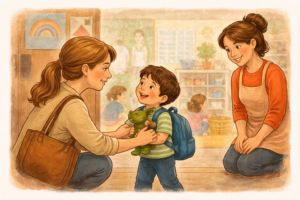
For me, in the classroom, it often starts with something very simple. I try to greet each child individually in the morning. And if I miss someone coming in, I make a point to notice them later and go back. Sometimes it’s just a quick hello, maybe a little joke or sometimes it turns into a longer moment. But it’s always intentional.
Because in those small interactions, I’m trying to say:
I see you.
You matter here.
I’m glad you’re here.
We also have to remember that every child is different. Some relationships come easily and others take time. Some might feel natural, while others require more intention. And sometimes—if we’re honest—we might not be the person a child connects with most. Just like in our adult relationships, not everyone “clicks” in the same way.
But even that gives us something important. An opportunity to reflect, learn and understand more about what that child might need—whether that’s through observation, conversation, or even doing a bit of our own research.
A few years ago, when I worked as a Movement teacher, I often heard something from other educators. They would say that my classroom was the “fun one”—and that’s why the children were listening better. I remember sitting with that, because something about it didn’t quite feel right to me. If I’m being honest, I don’t think it was about the activities being more fun.
I think it was the relationships, because when I look back, what I was really doing wasn’t anything extraordinary.
I was listening.
I was noticing.
I was remembering the small things they shared with me.
If a child had a big emotional moment, I would come back to it later and if I promised something—an activity, a game, even bringing something in—I tried my best to follow through.
And over time, those small things seemed to matter.
I’ve carried that with me into every classroom I’ve been part. Not as a strategy but just as a way of being. And more and more, I’ve come to believe that it’s not about being the “fun” classroom… It’s about being a place where children feel known.
I’ve been noticing this idea of connection showing up in very real ways during certain moments in the classroom. Especially during transitions—putting on outdoor gear, saying goodbye in the morning, or being reminded to go for a bathroom break. These are often the moments where some children seem to struggle the most.
One thing I’ve been reflecting on is how different responses from adults can shape how those moments unfold.
There are times when guidance becomes more directive with phrases like:
“You need to put that on.”
“I haven’t seen you try yet.”
“You have to go pee.”
Often paired with a firmer tone.
And in those moments, I’ve seen things escalate quickly. Sometimes into frustration and sometimes into full tears.
It has made me pause and wonder…
Is it about the child not listening or is it about how safe they feel in that moment?
I’ve also had to reflect on my own role in this. Because if I’m honest, I’ve had moments like this too. Moments where I moved too quickly and moments where I focused more on what needed to happen… than on what the child might be experiencing.
When I started to slow down and look a little closer, I began to see things differently.
Maybe it wasn’t about putting on mittens. Perhaps it was just hard in that moment. Maybe saying goodbye felt heavier that day or their play felt too important to leave behind so suddenly.
What looks like resistance… is actually an overwhelm, unknown feeling they are experiencing or feeling the loss of autonomy and control in their own little world.
Connection changes how children receive us and in those harder moments, it’s often not more control that helps—it’s the relationship.
I’ve also seen this show up in ways I didn’t expect.
At one point, a family asked if their child could be moved into my core group after I transitioned back to earlier shifts as they had noticed a change during drop-off.
He was coming in more easily, with more excitement and the separation felt… lighter.
When I reflected on it, I realised I hadn’t done anything big or different. I just took my time.
When I could see that letting go felt hard, I stayed a little longer in that moment with him.
Sometimes I offered him a small job to do or I asked a playful question to shift his focus.
Sometimes we wondered together about what we might do later that day.
Nothing complicated. Just small moments of connection.
And it made me realise something I hadn’t fully thought about before.
Relationships aren’t just felt by children. They’re seen by families too.
There have also been times when children have been moved out of my core group because they connected more easily with another educator.
It reminds me that relationships aren’t about being the right educator for every child. They’re about finding where a child feels most understood, most comfortable, most themselves. And sometimes, that might not be with me.
The more I reflect on all of this, the more I find myself thinking about how we build relationships isn’t about having the perfect approach. It’s about how we show up in the small, everyday moments.
For me, it often comes back to something that echoes so strongly through FLIGHT framework:
Noticing. Naming. Nurturing.
Not as a strategy—but as a way of being.
Noticing is about paying attention—but also about wondering. Not just seeing what’s happening on the surface, but pausing long enough to ask what might be underneath it.
The child who hesitates at drop-off.
The one who lingers a little longer during transitions.
The sudden change in energy, tone, or engagement.
The moments that are easy to label quickly— but hold more when we take the time to look again.
Noticing invites us to become curious. Instead of asking “Why aren’t they listening?” we begin to wonder “What might be making this hard right now?”
It’s also about noticing patterns over time.
The child who struggles in the same part of the day.
The one who needs a little more time to shift between moments.
The one who thrives when we slow down—even just slightly.
Because noticing isn’t just about observing children. It’s about understanding the relationship between what they’re experiencing—and how we’re showing up in response.
Naming is about giving language to a child’s experience—especially when they don’t yet have the words for it. Not to label or define it for them, but to sit beside what they might be feeling and gently make it visible.
“I can see that this feels hard.”
“That was really exciting for you.”
“You didn’t want that to end.”
Naming isn’t about being right, it is just having their experience acknowledged is enough to shift the moment. In those moments, when we choose to pause instead of react, we’re quietly telling them:
I see more than just the behaviour.
I’m trying to understand you.
You don’t have to figure this out on your own.
You matter enough for me to slow down.
Nurturing is about what we do with what we’ve named and noticed.
It’s the choice to stay. To slow down instead of move on, support instead of direct and to be with the child in the moment, rather than pulling them quickly out of it.
Nurturing doesn’t always look big. Sometimes it is sitting beside instead of calling from across the room, softening our tone, giving a little more time or offering help without taking over.
Not every moment looks like this. And not every day allows for it. But even small shifts can make a difference.
All of these moments—noticing, naming, nurturing—aren’t separate things. They’re happening all the time, in the smallest interactions throughout the day. So much of it lives in the small details like the language we choose, the tone we use and the way we position ourselves—physically and emotionally—in the interaction.



Sometimes, without even realising it, we respond from a place of what we need in that moment.
The schedule.
The transition.
The outcome.
But when we pause and shift our focus back to the child— who they are, what they might be feeling and what they might need— everything starts to look a little different.
Instead of:
“You need to…”
“I want you to…”
“You have to…”
We begin to shift toward:
“I can see that you…”
“What do you think we could do?”
“How can I help?”
And when I think about it, I often come back to how we, as adults, would want to be spoken to.
In moments where we’re overwhelmed, unsure, or struggling— would we respond best to being told what to do? Or to someone taking a moment to understand us first?
Most of us would want to be heard, to be given a bit of space and feel like our perspective matters. While children may not always have the words to express that— they feel it just as deeply.
So when we shift the way we speak, even slightly, we’re not just changing our language. We’re changing how the moment feels. And often… that’s what changes everything.
It doesn’t mean there are no expectations. It means we’re holding those expectations within a relationship, not over it.
As this series has unfolded, I’ve found myself coming back to the same idea when thinking about a successful classroom (most of the time), just from different angles.
At first, it looked like vision, then teamwork, then asking for help, and learning to be vulnerable. It looked like how we show up for each other and for ourselves.
Through all of it, something has been quietly sitting underneath.
That none of it really stands on its own.
Because the way we show up for our team shapes the environment we work in. The way we show up for ourselves shapes the energy we bring into the room. And the way we show up for children— that shapes everything else.
The safety they feel.
The trust they build.
The way they respond.
The way they learn.
And in all of that, we’re also showing them what relationships can feel like. How to listen, how to respond and how to be with others in moments that feel hard or uncertain.
I have realised that a successful classroom isn’t something we create in big, perfect moments.
It’s something we build in the in-between.
The pauses and in the way we choose connection when it would be easier to move on.
So maybe it was never really about finding the right system, or getting everything to work just right. Maybe it’s always been about how we show up for our team, for ourselves, and most of all—for the children in front of us.
Because that’s where it starts and, more often than not… that’s what carries everything forward.
Behind the crayons, successful classrooms aren’t built in a day, and they’re not perfect. They’re built in the small moments, the quiet shifts, and in how we choose to show up day after day.
— The Teacher Behind the Crayons
💬 I’d love to hear from you! Have you had a “pause and breathe” moment with your little learners? Or maybe a funny story about a fire drill and a glitter explosion? Share your thoughts, questions, or classroom wins in the comments below—let’s keep the conversation going.
References:
Government of Alberta. (2014). Flight: Alberta’s early learning and care framework.
https://flightframework.ca
Discover more from Behind The Crayons
Subscribe to get the latest posts sent to your email.

You May Also Like
Emotional Intelligence: Teaching children about Social Skills
August 17, 2025
My Successful Classroom (Most Of The Time): The Strength I Didn’t Understand Yet
March 22, 2026