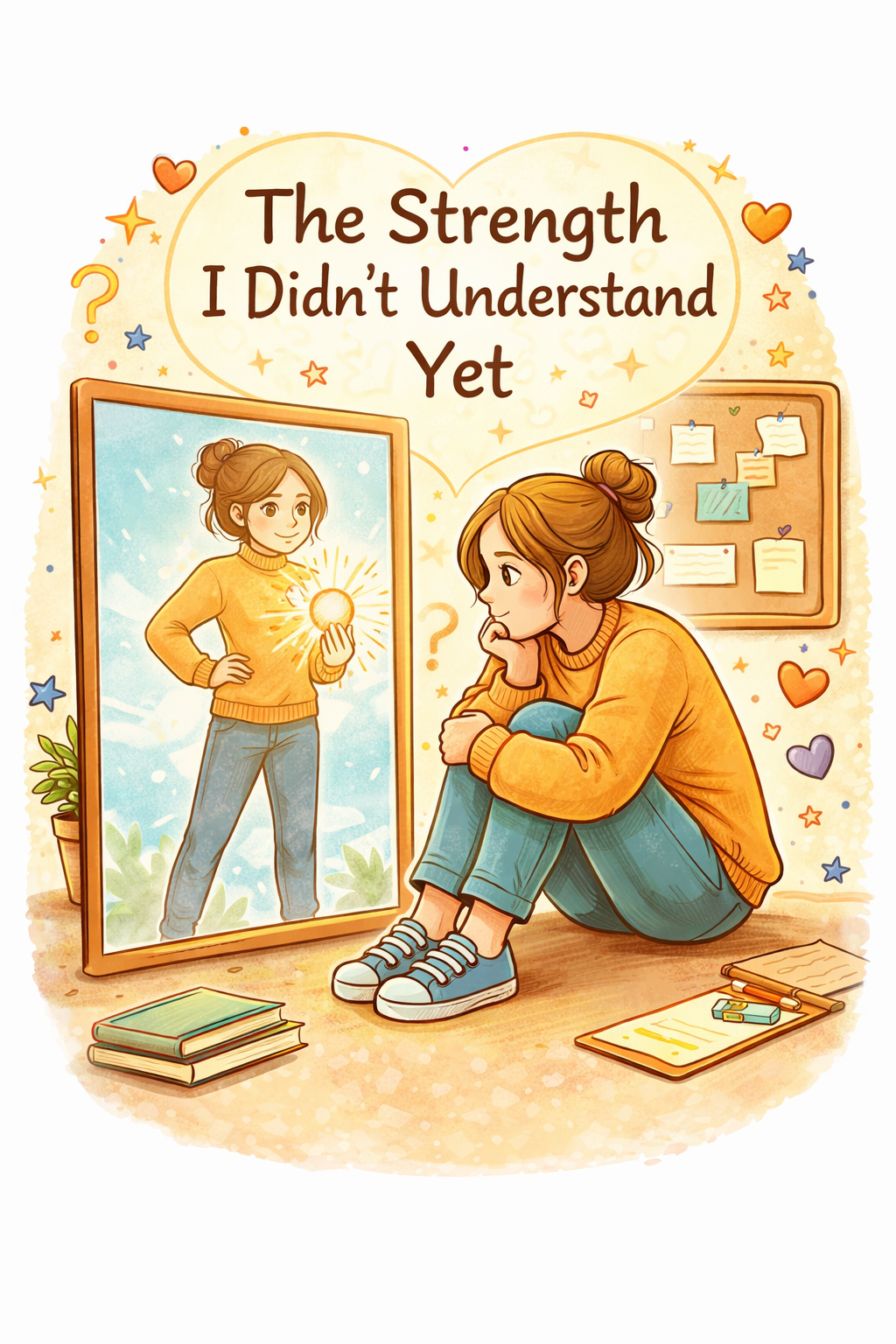
My Successful Classroom (Most Of The Time): The Strength I Didn’t Understand Yet
In this series I’ve been reflecting on what actually makes a classroom successful — not in theory, but in the everyday reality of working with children and the adults around them.
In the last post, I wrote about strong teams. About how successful classrooms are rarely built by one person doing everything, but by people learning how to carry the room together.
But there’s another kind of strength that sits underneath that.
A quieter one.
Before we ask whether support is available around us, we often have to ask something harder:
Can I admit that I need it?
Because no matter how strong a team is, if we don’t recognise when we are overwhelmed, unsure, or reaching our limits, we can still end up carrying more than we realise.
And that’s the part of strength I didn’t understand yet.

In education we often encourage children to ask for help when something feels difficult. Yet as adults, many of us hesitate to do the same. Sometimes we worry about appearing inexperienced, think we should already know the answer and sometimes we simply get used to carrying things quietly.
We often talk about psychological safety as something created within a team — a shared understanding that it’s safe to ask, reflect, and not have all the answers.
But I’ve come to realise that even when that space exists, we don’t always allow ourselves to use it.
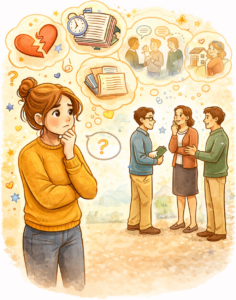
There was a time in my career when I believed that being a strong educator meant staying one step ahead of everything. When something needed fixing, I fixed it. When someone struggled, I stepped in. When something felt uncertain, I tried to control it.
At the time, that was my definition of my strength and in many ways, it made sense.
Research often highlights a range of qualities that define a strong educator. It speaks about the importance of building trusting relationships with children and colleagues, remaining calm and responsive during challenging moments, reflecting on practice and adjusting when something isn’t working, collaborating with others, taking responsibility, and balancing structure with flexibility in meeting children’s needs.
All of those things matter as they shape the foundation of what we do every day.
But the more I reflect on it now, the more I realise that the idea of what a “strong educator” looks like can mean very different things to different people. Sometimes the expectations are only set to checklists — completing forms, following procedures, doing what you are told and making sure everything appears to run smoothly. Systems and accountability have their place but strong education cannot live only inside checklists.
Even beyond that, something else began to stand out to me, both in research and in practice, that one of the most important pieces is often left unspoken. The ability to recognise when we need support. To ask for help.
Because that doesn’t come from knowledge alone. It comes from self-awareness — from understanding not only what is happening in the room, but also how we are responding within it.
In many ways, strength within ourselves is less about having all the answers and more about being willing to learn, adapt, and grow — not just as educators, but as people.
And sometimes, that growth begins with something as simple — and as difficult — as saying,
“I might need help with this.” (Preferably before the third cup of coffee and not after everything has already unravelled.)
But what I didn’t see at the time was how much of my understanding of strength was happening internally. I wasn’t just trying to do things well. I was trying to stay in control.
From the outside, it looked responsible but underneath that responsibility was something else. I realised I had confused strength with control that had quietly become my way of staying stable.
And what I thought was competence was often just independence taken a little too far.
And that worked — until it didn’t.
I think many of us treat small stressors as nothing.
We brush them off. We tell ourselves it’s just a busy day, just a difficult moment, just something that will pass.
Eventually.
Well… I have clear experience that they don’t. Some of you might be the troopers who haven’t felt the effects — and truly, good for you for being able to look out for yourself.
It took me far too long to understand the power of asking for help — even in moments that don’t feel that significant.
I have now realised that talking about what feels difficult, some days more than others, is like practice in reaching for a helping hand when the bigger moments come.
But there’s also a balance to learn- if we rely on help for everything, we stop challenging our own thinking. We stop growing through discomfort. So it’s not about asking for help all the time — it’s about knowing when to reach for it.
I think we all have moments that have felt like they needed to happen. Not because they were easy — but because they shaped who we are becoming.
My story of understanding the importance of asking for help wasn’t one moment. It was years of small stressors I brushed off — slowly building into something much bigger.
I remember a day, about five years ago, when I had what I can only describe as a small breakdown at work. It felt like it came out of nowhere.I cried, told myself it was just one of those moments, that I would be fine — even with personal struggles and instability around me.
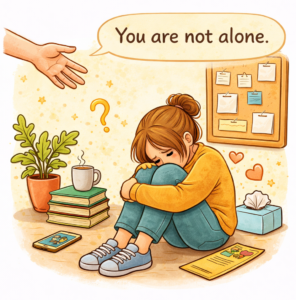
Then someone close to me said something very simple:
“You are not alone.”
At the time, I heard the words. But I didn’t really understand them nor believe them. Thinking about it now, that moment was already pointing to something I hadn’t yet learned:
Strength isn’t about always holding yourself together on your own. It’s also about recognising when you shouldn’t have to.
Over the years there have been a few more of those “breakdown” moments that started increasing in difficulty to come out of. I didn’t seek help of any kind at first because I have always been a strong independent woman who picks herself back up and keeps going.
Until the breakdowns became panic attacks.
I started feeling that I need to seek professional help. Even made appointments. But the appointments were scheduled weeks later and by the time it was time to go I cancelled them, because I was fine- at least it felt like it.
After speaking to my family doctor several times, I started trying different things from reading, changing lifestyle to some capacity, creating goals for myself and was even prescribed emergency medication to avoid full blown panic attacks. But that didn’t help to go through what was ahead.
Then there was an incident in my classroom. A child was hurt during an activity because I had left some tools unattended. The injury itself wasn’t severe, a few stitches on the finger, but it was serious enough to shake me deeply. I took responsibility immediately. We reviewed what had happened, and together with management we implemented clearer safeguards so something similar wouldn’t happen again. Professionally, the situation was handled well and we are all human- mistakes happen.
But internally, something shifted. Not all at once. Quietly.
Even though I knew we had addressed the mistake, my mind didn’t quite let it go. It became another layer — another piece added to everything that had already been building underneath.
It became something I carried as a failure. I felt like I had failed the child, failed the family, failed my colleagues, and above all — failed myself. It eventually manifested as PTSD.
I had always seen myself as a safe educator, someone careful and in control. Something like this, I believed, should never happen.
Not on my watch anyways.
At the same time, life outside of work wasn’t entirely steady either. Personal pressures were there too, even if I didn’t fully acknowledge them.
And work became the place where I tried to hold everything together.
Looking back, I can see that this moment didn’t come out of nowhere. It was part of something that had been building for a long time. I can see how much pressure I was carrying without realising it and not just from the situation but from the expectations I had placed on myself.
And then, about 6 months later, my body reached a point where it couldn’t keep up with that pace anymore. The panic attack didn’t come out of nowhere.It was the moment everything caught up at once. What had once felt manageable suddenly felt overwhelming. Small stressors became enormous.
What I didn’t understand at the time was that those moments were not isolated events. They were pieces of a bigger picture slowly forming in the background and when we ignore those pieces for long enough, eventually the picture becomes impossible to ignore.
For the first time in my career, I had to step away and take medical leave and in that moment, something became very clear. The problem wasn’t just the workload. It wasn’t just the incident.
It took a long time of build-up unresolved and unaddressed moments when I decided not to ask for help and the belief that I had to carry all that by myself.
I was off for a month and in that time, I didn’t do much. Which, for me, was something I had never really allowed myself before. For the first time, I had the space to just be. Not thinking about work. Not making plans. Not trying to “use the time productively.” (Because, let’s be honest, even a holiday can become another thing to manage.)
At first, it felt uncomfortable.
I remember thinking, How can you not do anything?
You’re going to make this worse.
This is wasted time — you could be doing something, fixing something, moving forward.
But it wasn’t wasted time, it was a reset. The kind I didn’t realise I needed. A space without expectations, pressure to keep going and in that space, I started to see things differently. I realised how much support I actually had around me. From my workplace, from friends, from family.
I wasn’t alone.
I had just been acting like I was.
That realization shifted something. I started allowing myself to make choices that supported me — not just everyone else. (Still a work in progress, if I’m honest.)
I began to understand that taking care of myself wasn’t a burden to others. It was a way of taking the weight off myself.
That month gave me the space to re-evaluate what I needed — not just to return to work, but to return differently. And slowly, I started listening to my body in a way I hadn’t before. Especially when it was telling me to rest.
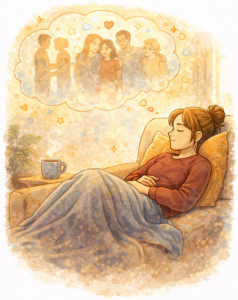
When I returned to work, I’ll be honest — it felt daunting at first. There was still a quiet sense of guilt sitting underneath it all. The kind that makes you wonder how your absence affected everyone else, and whether you’ve somehow let people down (the overthinking we do so well).
But what I walked back into felt very different from what I had expected. I was welcomed back with a kind of warmth that caught me off guard. Not because everything had been easy — but because people could see that I was better.
It was only later that I found out some of my colleagues had gone to management before I stepped away, because they were worried about me. At the time, I hadn’t seen it that way. I told myself it would pass — like it always had before. Until it didn’t.
We then had a professional development day.
One of the activities was simple — we were randomly assigned a colleague and asked to reflect on when we had seen them at their best. Not in theory but in real moments.
One of my colleagues — someone who knew me well — said something that stayed with me:
“You were at your best at your worst.”
I remember sitting with that for a moment because that wasn’t how I had seen it.
Apparently, my definition of “falling apart” looked very different from someone else’s definition of “showing strength.” To me, that time had felt like failure, losing control and not being the person I thought I was supposed to be. But through someone else’s eyes, it looked different. It looked like strength.
She explained that it was the first time she had seen me put my hands up and say,
“I can’t do this. I need help.”
And also the first time I chose to step aside and give myself the space to heal.
And that’s when something shifted. Because maybe strength in this work isn’t about holding everything together. Maybe it’s about knowing when not to.
That’s one of the reasons I believe asking for help matters so much. Not only in the big moments, but in the small ones too. It doesn’t always have to mean therapy right away. Sometimes it simply means talking to someone, sharing a moment that bothered you, or saying out loud that something felt difficult.
Often, another person can help us see a situation from a different angle — one we couldn’t see while standing inside the stress ourselves.
Looking back, I came to understand that what I experienced wasn’t a sudden lesson. It was a natural consequence of all the moments I chose not to ask for help. And now, I can recognise when I start drifting toward that same path — and respond differently, before it builds into something bigger.
In a strange way, that realisation brought me back to something that keeps showing up throughout this series — that what we bring into the room as adults shapes far more than any system or plan ever could.
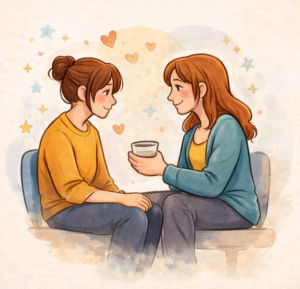
Sometimes growth begins in moments that feel deeply uncomfortable.
As psychiatrist M. Scott Peck once wrote:
“The truth is that our finest moments are most likely to occur when we are feeling deeply uncomfortable, unhappy, or unfulfilled. For it is only in such moments, propelled by our discomfort, that we are likely to step out of our ruts and start searching for different ways or truer answers.”(Peck, 1978)
For me, that moment came when everything I thought was holding things together finally broke apart.
But in that breaking, something else became possible.
Not just a different way of working — but a different way of being.
And part of that shift was learning to speak about it — openly. Not as something to hide or feel ashamed of, but as something that shaped me. Because the more I allowed myself to be honest about what I had been through, the more I noticed it gave others permission to do the same. I realised that one of my strengths wasn’t holding everything together. It was allowing myself to be vulnerable.
We talk about mental health differently than physical health, but really — it shouldn’t be that different. If you injure your leg, you don’t question whether you “should” take time to heal. You rest. You recover. (Or in my case… you rent a scooter and roll around the classroom like nothing happened.)
But when it comes to our mental health, we push through. We minimize and convince ourselves it’s not “serious enough.”
And yet, I’ve learned this the hard way — I can still be a good educator with a physical injury. But I cannot be the educator I want to be if I’m not taking care of my mental health. Because how I show up internally shapes everything I bring into the room.
Asking for help doesn’t mean giving up responsibility. It also doesn’t mean expecting others to solve every challenge for us.
There is a balance.
Support should strengthen our capacity — not replace it. That’s why one question has become important to me over time:
What can I do to change this?
Not in a blaming way but in an empowering one. That question moves us from helplessness to agency.
Behind the crayons, strong classrooms are not built by the people who never need help. They’re built by people who are willing to learn, reflect, and allow themselves to be vulnerable.
Because strength isn’t about carrying everything. Sometimes it is simply knowing when to say,
“I need help.”
— The Teacher Behind the Crayons
💬 I’d love to hear from you! Have you had a “pause and breathe” moment with your little learners? Or maybe a funny story about a fire drill and a glitter explosion? Share your thoughts, questions, or classroom wins in the comments below—let’s keep the conversation going.
References
Peck, M. S. (1978). The road less traveled: A new psychology of love, traditional values and spiritual growth. Simon & Schuster.
Discover more from Behind The Crayons
Subscribe to get the latest posts sent to your email.


You May Also Like
Emotional Intelligence: Teaching children about Self- Awareness
June 20, 2025
Behind The Crayons the Labels Blur…
February 16, 2026