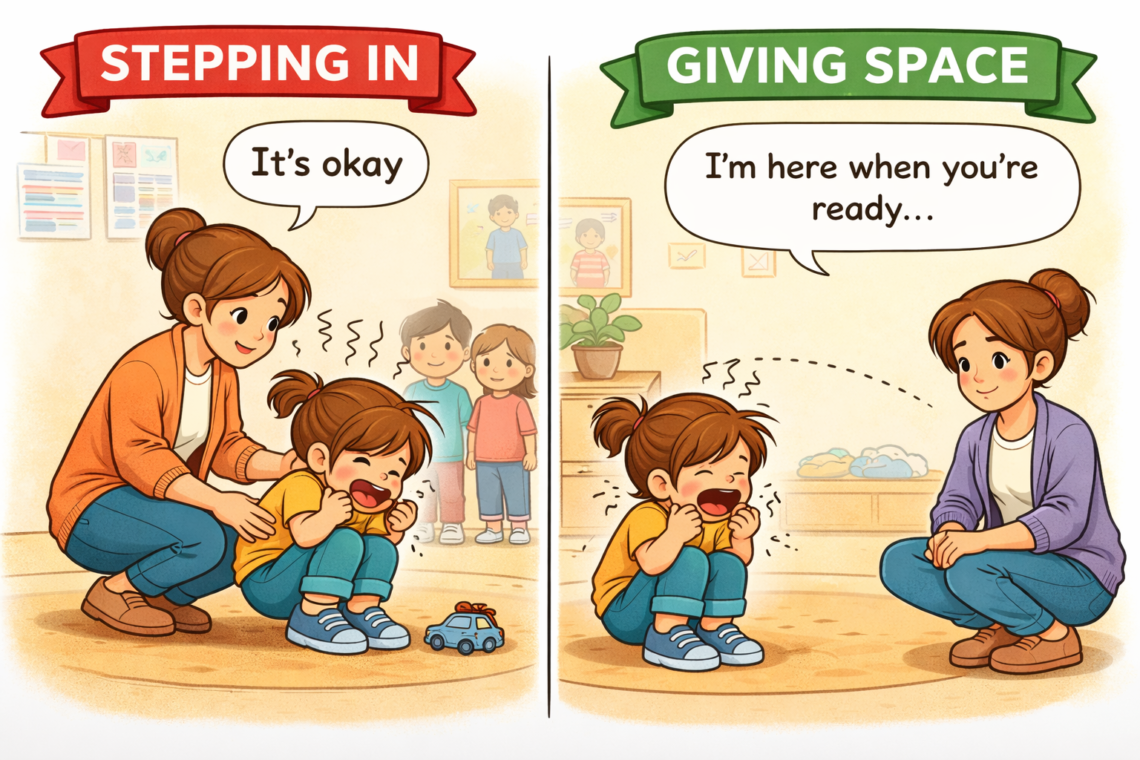
Are we supporting regulation… or interrupting it?
When I first started this blog, I wrote a whole series on emotional intelligence, and I found myself returning to self-regulation again and again—how it develops, how we support it, and why it feels so important in the early years. It is important and it’s also something that seems to be everywhere—part of so many conversations, questions, and ideas about supporting children today.
Lately, I’ve been wondering something different. We spend so much time talking about teaching self-regulation, offering children strategies and support, but I’ve started to question whether we are giving them the time and space to actually live through those moments.
When regulation is needed most—the loud, messy, unpredictable moments that don’t fit neatly into our plans—I’m not sure we always stay with it long enough. Sometimes we step in, sometimes we guide, and sometimes we move things along… and only later I find myself wondering if I supported the moment, or actually interrupted it.

Experience:
It started like many moments do. Two children, one material and two very confident voices.
“I got that first.”
“No, I got it first.”
The voices got louder, the hands got tighter, and before long, they were both pulling on the same piece—each one certain it belonged to them. I walked over, already putting together what I thought had happened. I had seen enough of the play to feel confident stepping in quickly.
“I think she had it first,” I said, gently guiding the material toward the other child. “You can have a turn later.”
And that’s when Jane’s body changed. It was almost immediate. Her shoulders tightened. Her face scrunched. And then—she dropped right onto the floor crying, stomping and her whole body speaking louder than her words could. I moved closer, lowering myself beside her, already trying to help her through it.
“Jane, you’re okay,” I said softly.
“We can use our words.”
“You can ask for a turn.”
“Let’s take a deep breath.”
But the more I spoke, the louder her cries became. Her feet pushed hard against the floor. Her hands hit the ground. The sound of it filled the room—heavy, sharp, impossible to ignore. I could feel the eyes of the room shift. The noise, the movement and the intensity of it. And without even realizing it, I leaned in more.
“Jane, we don’t need to stomp.”
“Your body needs to be safe.”
“Talk to me.”
At one point, she kicked toward me—not out of anger at me, but out of something bigger she didn’t yet know how to hold. And still, I stayed right there in it—talking, guiding, correcting—trying to bring her back. I thought I was helping and supporting her through the moment, but looking back, I can see how quickly I stepped in and how much I filled the space. Then I started to wonder about something else.
Was I supporting her regulation… or had I already interrupted it?
I thought I was helping solve the problem but I hadn’t stopped to notice what was already unfolding.
It’s not always a conflict over materials. It can be at drop off time, meal times, well any time to be honest. Sometimes it is a child in the middle of a transition: boots off, jackets half-zipped and the room already shifting toward what comes next.
“My socks are wet.”
And just like that, everything stops. The body drops, the tears come quickly, and the moment begins to take up more space than the room feels ready for.
In that split second, where does your mind go?
To the other children still waiting?
To the fact that lunch is now running late?
To how small wet sock problems might seem in the middle of everything else?
To the plan you had for how this transition was supposed to unfold?
None of these thoughts make us bad educators. They make us human in a busy room. But they do shape what happens next.
There are countless strategies out there to support children in learning self-regulation from breathing techniques and games to prompts woven into everyday routines.
We talk about teaching self-regulation…but are we allowing children the time and space to actually practice it?
Interruption doesn’t always look harsh, sometimes it looks like care.
Stepping in quickly. redirecting before things escalate and expecting the moment to resolve neatly. Underneath it though, something else can be happening.
Rushing in with corrections.
Over-guiding the response.
Expecting compliance… instead of allowing the process to unfold.
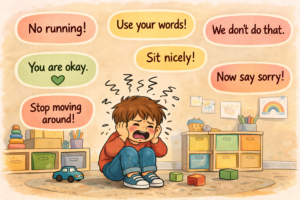
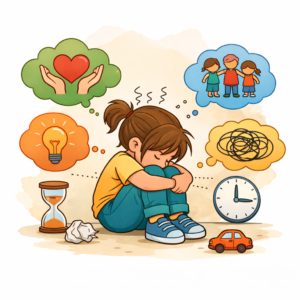
If regulation begins with awareness, then what happens when we interrupt the moment before a child even has the chance to notice what’s happening inside them? Before they feel the tightness in their chest, recognize the frustration building in their hands, or begin to connect what their body is doing to what they are feeling.
These are the things we intentionally practice in quieter moments. In my classroom, we come back to them often during our Peace of Mind sessions—through body outlines, through noticing language, through slowing things down enough for children to begin recognizing what is happening inside their own bodies. It’s where awareness begins to take shape.
But when those real moments arrive—when emotions are no longer calm and contained, but loud and physical and urgent—the response can sound very different.
“It’s okay.”
“You need to…”
“Calm down.”
The intention is still there. We are trying to help, to guide, to support. But the experience for the child shifts. Instead of being given the space to notice what is happening within them, the moment is redirected before that awareness has a chance to form. And over time, what are we showing children about those moments? That they should move past them quickly? That the feeling itself is something to fix, rather than something to notice?
And just like awareness, the development of other parts of emotional intelligence can be shaped in these moments too. When we interrupt a child’s process before it has had the chance to unfold, we are not only influencing what they notice within themselves, but also how they come to understand others, their own motivation, and the social world around them.
We often talk about empathy as looking beneath behaviour—trying to understand what is driving the action. But what happens when we focus only on what we see on the outside, and not on the regulation process happening within the child? When we respond to the behaviour, rather than staying with the experience that is still unfolding, we may unintentionally show that discomfort needs to be minimized, that big feelings should be moved through quickly, and that understanding comes from someone else stepping in, rather than being built from within.
And the same question begins to echo further.
Does constant correction build motivation, or does it teach children to rely on us to guide each step?
Does expecting immediate compliance give them space to explore social skills, or does it take away the opportunity to navigate those moments for themselves?
And if we keep pushing children through these experiences, are we showing them what empathy looks like—or simply how to move past it?
If regulation is something we want children to own, then it has to be something they are allowed to experience. When we step in too quickly, we don’t just support—we can unintentionally take pieces of that process away.
Autonomy becomes, I’ll fix this for you.
Competence becomes, You’re not handling this well.
Relatedness becomes, This behaviour is a problem, instead of you’re having a hard moment.
Not because we mean to, but because the moment feels urgent, loud, messy or because it interrupts what we thought the moment would look like.
Experience:
It started the same way.
Two children. One material. Two very certain voices.
“I got that first.”
“No, I got it first.”
The pulling begins, the voices rise, and I walk over—only this time, I pause before deciding what happened.
“I’m not sure who had it first,” I say, keeping my voice steady. “Let’s figure it out together when we’re ready.”
But the moment doesn’t settle.
Jane’s body still tightens. Her face scrunches. And then—just like before—she drops. Right onto the floor. Crying. Stomping. Her whole body taking over in a way that feels bigger than words.
And even without the quick decision, the feelings are still there.
Strong. Loud. Real.
This time, instead of stepping in to guide the moment, I shift my focus.
I make sure she is safe. That her body has the space it needs. That nothing around her will cause harm. And then I stay nearby.
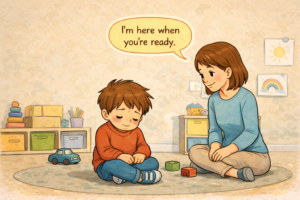
“I’m here when you’re ready,” I say quietly.
And then I wait.
The crying doesn’t stop right away. The movement doesn’t soften because I said something different. It still takes time—longer than feels comfortable, longer than fits easily into the rhythm of the room.
Around us, the day continues. Other children are still moving through their play, the transition is still waiting, and I can feel that familiar pull to move things along.
But I stay.
And slowly, there are small changes.
The stomping becomes less forceful.
The crying begins to quiet.
Her body, little by little, starts to settle.
I don’t rush in. I don’t fill the space.
Just now and then, I check in gently.
“Are you ready?”
Not to push the moment forward—
but to open the door when she’s ready to step through it.
And when she is, that’s when we talk. Not in the middle of the storm, but after it has passed. We come back to what happened, what felt unfair, what she noticed, and what we might try next time.
Because the goal in that moment isn’t to stop the feeling.
It’s to stay alongside it as it moves through.
What if regulation actually looks like this—not neat or controlled, but messy, physical, and inconsistent? Not always quiet, and not always compliant. What if what we are seeing in those moments is not the problem, but the process itself unfolding in real time?
So often, we notice the movement before we notice the regulation happening underneath it. We see the disruption, but not the attempt. And without even realizing it, we step in before the learning has had a chance to unfold.
Maybe this is where the shift begins. Not in doing less, and not in stepping away completely, but in becoming more aware of our timing. Because when we rush children through these moments, we might not be resolving them—we might be pushing them aside. And those feelings, those experiences that haven’t had the space to be worked through, don’t simply disappear. They tend to return, often louder, often bigger, still looking for a way to be understood.
It reminds me that this isn’t really about whether we help. It’s about how quickly we step in.
Perhaps it looks like learning to sit beside the moment instead of stepping into it too soon. Offering fewer words. A quieter presence. Saying, “You are safe,” and “I’m here when you’re ready” instead of “You are okay.” Maybe, in that moment, they’re not okay—and that matters. But they are safe enough to move through it.
And maybe, more than anything, it’s about learning to wait… just a little longer.
Behind the crayons,
I’m starting to wonder if it’s not that children struggle with regulation— but that the moments they need to practice it don’t always get the space they deserve.
And maybe the question isn’t just how we support regulation… but whether we are giving it the time to unfold.
Because sometimes, the moment we’re trying to move through is the very one a child needs to stay in.
— The Teacher Behind the Crayons
💬 I’d love to hear from you! Have you had a “pause and breathe” moment with your little learners? Or maybe a funny story about a fire drill and a glitter explosion? Share your thoughts, questions, or classroom wins in the comments below—let’s keep the conversation going.
Discover more from Behind The Crayons
Subscribe to get the latest posts sent to your email.

You May Also Like
My Successful Classroom (Most of the Time)
March 1, 2026
My Successful Classroom (Most of the Time): Strong Teams Build Strong Classrooms
March 15, 2026